The EU AI Act is here.
And for many companies, the biggest challenge is no longer just compliance - it is knowing where to start.
Until now, ComplianceRadar allowed teams to scan live websites and instantly understand their AI risk classification.
But we kept hearing the same question from engineering teams and B2B clients:
"What if our product isn't live yet?"
"How do we validate compliance before we even build it?"
Compliance Before Code
Today, we are introducing a major new capability:
Enterprise PDF Architecture Scanning
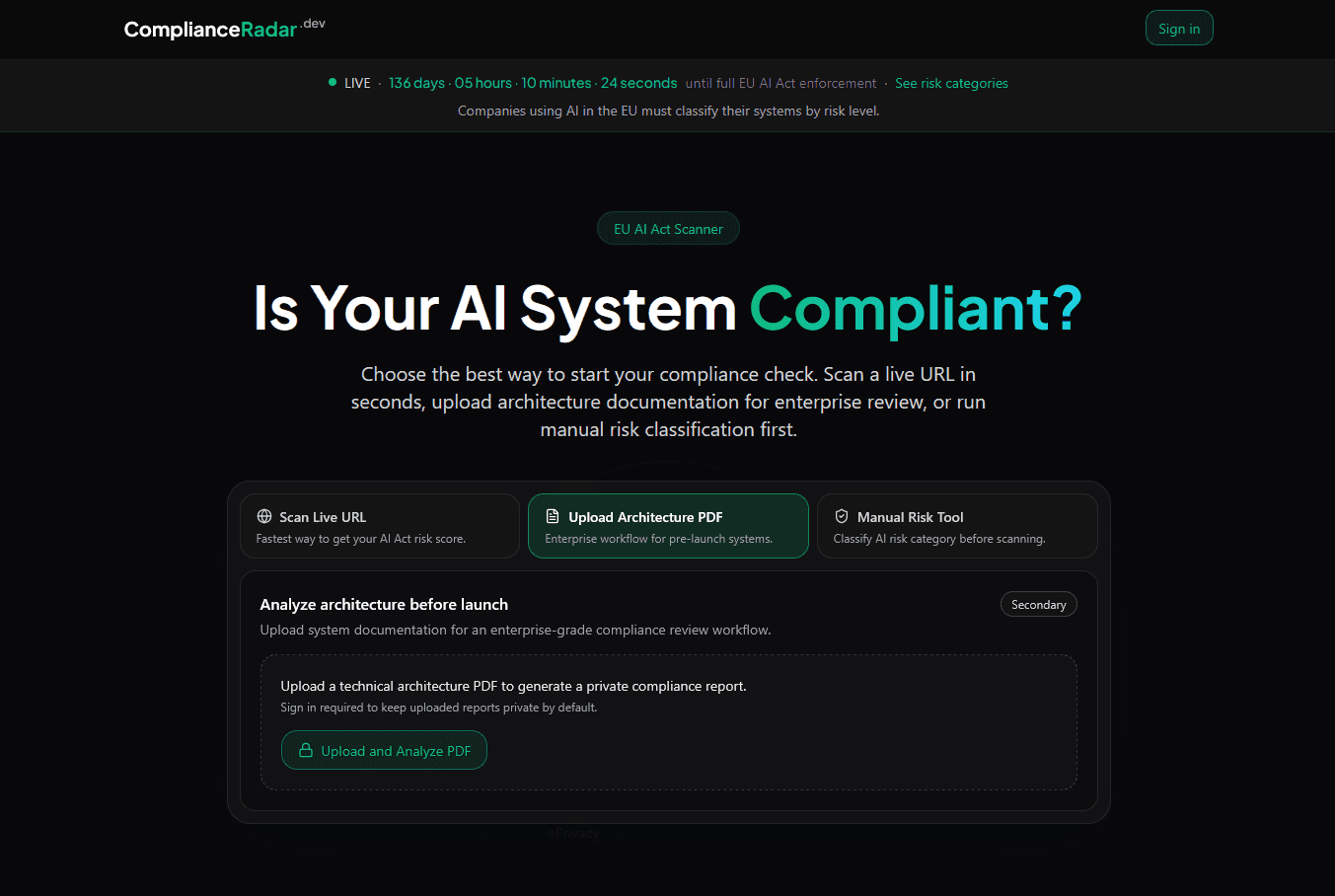
You can now upload your technical architecture documentation (PDF) directly into ComplianceRadar.
No live system required.
Within seconds, the system:
- analyzes your architecture
- identifies regulatory risks
- maps findings to EU AI Act requirements
- generates a structured compliance report
Including early-stage alignment with Annex IV documentation expectations.
Why This Matters
Most compliance issues are discovered too late:
- after deployment
- after audits
- after legal review
At that point, fixing them is:
- slow
- expensive
- disruptive
By scanning architecture before development, teams can:
- identify high-risk use cases early
- avoid costly rework
- design systems with compliance in mind from day one
Built for Enterprise: Privacy by Design
We understand that technical architecture documents are among the most sensitive assets a company has. That is why this feature is built around strict data protection principles.
Zero Retention Processing
Once the report is generated:
- raw PDF files are permanently deleted
- extracted text is discarded
Only the compliance insights are retained.
Data Minimization
The system is designed specifically for:
- technical architecture
- system descriptions
This significantly reduces compliance risk on the client side.
Private by Default
All generated reports are:
- tied to your authenticated session
- not publicly accessible
- isolated from other users
From Scanner to Compliance Workspace
With this update, ComplianceRadar evolves from a simple URL scanner into a broader AI compliance workspace.
You can now:
- scan live websites
- run manual assessments
- analyze pre-launch architectures
All in one place.
Try It Today
Whether you are:
- validating a live product
- designing a new system
- preparing for EU AI Act compliance
ComplianceRadar helps you understand your risk before it becomes a problem.
Run your free compliance check
Upload architecture docs or scan a live site to detect AI Act risks early and plan compliance work before it becomes expensive.
Final Thought
The biggest compliance mistake is not failing an audit. It is building a system that was never compliant in the first place.
With PDF architecture scanning, you can shift compliance left - from legal review to system design.
Sources and further reading
- Regulation (EU) 2024/1689 (EU AI Act) - EUR-Lex
- Annex IV documentation context - EU AI Act
- EU AI Act vs GDPR: What AI Startups Need to Know
- EU AI Act Explained for Developers
This article is informational and does not constitute legal advice.